Wednesday, March 18, 2015
Kenya's Sinking Venice Pavillion
Monday, March 16, 2015
African Contemporary and Modern Art Auction 2pm, 26th March online via London's The Auction Room
![]() |
MAÏMOUNA GUERRESI (B.1951, ITALY) ROKHAYA (FROM THE GIANTS SERIES) Lambda print
100 x 63 cm Executed in 2010, Estimate: £4,000 - £6,000
|
This sale presents a great opportunity to bid for highly sought after works by Maimouna Guerresi, Fabrice Monteiro, Goncarlo Mabunda, Pascale Mathine Tayou, Ablade Glover and many others at favourable prices.
Selected works will be on view at Mallet, 37 Dover Street, London W1S 4NJ from 19th - 26th March 2015 10am - 5pm, Mon - Fri (weekends by appointment).
Sunday, March 15, 2015
Mario Macilau: The Road Not Taken
His Out of Town works focus on neglected communities – the image below is of a Maasai man taken in Kenya in 2014.
Thursday, January 30, 2014
Ismaila Manga: myths, signs and symbols
Wednesday, January 8, 2014
Nathalie Bikoro and the language of history
Thursday, December 12, 2013
Kimathi Donkor - a figurative master
Ed Cross interview: African art and developments in the online market
http://issuu.com/richardmudariki/docs/85/1?e=8722852%2F5808048
Monday, December 9, 2013
The tipping point for contemporary African art?
Friday, June 21, 2013
Joseph Bertiers and "The True Lier"
Wednesday, June 5, 2013
Mário Macilau and the Price of Cement
Saturday, February 11, 2012
Cyrus Kabiru - visionary artist
Cyrus Kabiru | C-Stunner series - Identity | Cyrus Kabiru is one of the most exciting artists to emerge from the burgeoning Nairobi art scene. His recycled materials "C-Stunner" works are witty, humorous, profound but unpretentious. And I am not alone in admiring his work - interest from all over the world has been unprecedented and is growing.
Here is small piece I wrote on my new blog Ed Cross Fine Art
and here is just one of many articles about him, this one from the interesting Makeshift site.
Kabiru had a show in Holland last year at Kuntspodium T Gallery in Tilburg and we are planning exhibitions in the U.K. ,U.S.A and elsewhere.
Enquiries to ed@edcrossfineart.com
Wednesday, April 13, 2011
Soly Cissé


Soly, as many of you will know, is one of Senegal's most successful and prolific artists - he paints with gusto - and I believe some of his work is truly inspired. It has that sense of the mystical and there is a vigour about the work and the man that is exciting.
Here are some very strong works from a series that he has only just produced - they are all 80 x 80cm acrylic and pastel on canvas.
email me quickly if you are interested by them as his work is in demand.
ed@edcrossfineart.com
http://edcrossfineart.com/cisse.html
Tuesday, April 5, 2011
Life Imitating Art: Michael Soi, the ICC and the "Ocampo Six"
Michael Soi | Hague Express No 5.| 77cm by 65 cm| 2011Since April 2008 , Nairobi artist, Michael Soi, has been producing a series of paintings entitled Hague Express celebrating the hoped for departure from Kenya of those (to be) indicted by the ICC over their role in the 2007/8 post election violence which claimed 1220 lives, uprooted whole communities and lead Kenya to the brink of civil war. Today (April 5th 2011) Kenya witnessed the fulfillment of Soi's prophetic vision as some of the accused flew out of Nairobi on a KLM flight to Holland - all six accused will soon be at the International Criminal Court. In a poll from the Kenya's Daily Nation published today 61% of those polled approved of these prominent men being hauled out of the country to face justice in Europe. Real justice at home would be better but this development is viewed as a massive step in the battle against what is now viewed by many as the the biggest evil of them all - impunity.
Michael Soi | City in The Sun | 122 x 183cm | 2011 Michael Soi's wish for justice is shared by almost all Kenyans, and he was not alone in producing politically charged work in the early part of 2008 whilst his country teetered on the brink and his countrymen were slaughtered by incentivised mobs. But he was possibly unique in painting his vision of a desirable outcome and faithfully continuing this until - almost miraculously - Messrs Ruto, Kenyatta et al, were forced to head to the Hague (with expensive government lawyers in tow) this week. Soi is understandably proud and pleased that Sr Ocampo himself is the owner of painting No 4 in the series.
Soi is something of an amiable giant -ruled by an irrepressible sense of humour and a satirical but benevolent view of life. He is all artist and no politician - but he like many other Kenyan artists are profoundly concerned about standing up against injustice.
The visual arts in Kenya are still a minority interest - there is no National Gallery, the National Museum leaves a lot to be desired when it comes to contemporary art - but artist groups like Kuona Trust , where Soi has his studio, have flourished and little by little contemporary artists are leaving their mark on the national consciousness through exposure via newspaper reviews probably more than anything else. Kenya's cartoonists - Gado being the most famous - have for years flown the flag of cheeky defiance - even during the dark days of the Moi regime. Soy who is an artist - not a cartoonist - is nevertheless an inheritor of that brave and humorous tradition. His work is Hogarthian in its rollicking satirical portrayal of everyday hypocrisy and farce. His characters engage you in a way that is uniquely Kenyan. And he has developed an economical and powerful visual language that will ensure him an important place in the country's art history. They used to say that all the important art came from West Africa - well that was not true then and it certainly isn't now.
For further information about works by Michael Soi contact me by email ed@edcrossfineart.com
Ed Cross 4th April 2011
Sunday, February 13, 2011
Sekano's Women
Given the scarcity of art schools across much of the African continent it is not surprising that many of this continent's finest artists are "self taught", but whilst many artists like Richard Onyango and Jak Katarikawe are musicians (Eduard Saidi Tingatinga from Tanzania started out as a Makonde dancer) it is relatively rare to find a man who invented himself as both painter, poet and pianist. Such a man is the South African (former exile) artist - Charles Sekano. Thirty years of his life was spent in Kenya (from the 60s – 90s) escaping the poison of apartheid. His bold and passionate use of colour - a one man crusade against any kind of colour bar.
An uneasy relationship with publicity, which as his gallerist I have just frustratingly experienced at first hand, has contributed to his being more of an artist's artist, though he is a legend to many with a serious interest in East African art. He has unapologetically existed in the shadows, like so many of the subjects of his paintings. There is frequently a romantic longing within artists for their work to remain purely personal unsullied by the often crass categorisation of the public. I know this from my own work as an artist. Sekano has achieved fame – his work is to be found in New York as well as Nairobi, and in important museum collections in the States but now approaching seventy he remains the rebel – always at his happiest playing his piano in a darkened nightclub.
One of the visitors to my current show of Sekano's work commented "you can tell the works were done for himself alone" and it's true there is no sense of anything else but the artist and his immortalised subject - often a beautiful young woman in the unforgiving urban African night. Sekano's women are not sentimentalised or even romanticised they portray a stubborn range of human emotion from nostalgia to sulkiness, to maternal instinct to narcissism to pride, ambivalence, coyness and sadness - all depicted with cryptic precision.
View a catalogue of the exhibition
Sunday, January 9, 2011
Peterson Kamwathi
Peterson Kamwathi Untitled Digital Print 650mm x 480mmThis remarkable print by the Kenyan artist, Peterson Kamwathi whom I work with in London, was born of a collaboration with the Kenyan poet Shailja Patel for the South African based project Dialogue Among Civilizations The Art of Human Rights you can read Shailja's poem What we want on this link.
I think Kamwathi's print makes its point with economy and subtlety, demonstrating the strength, beauty and vulnerability of human communities.
There is a very illuminating London article/interview with Kamwathi by Karen Dabrowska which gives a real sense of both the man and his work.
Peterson Kamwathi explaining Kenya through woodcut prints and icons
and we produced a full catalogue of the artist's last show in London with an essay by the SOAS art historian, Elsbeth Court, and an interview with fellow artist Sam Hopkins together with images and details of all the works in the show. Do check it out...
...Matter of Record... Catalogue
Thursday, December 30, 2010
Charles Sekano - House of Women

Charles Sekano in the 1980s
Born in Sophiatown, Johannesburg in 1945, Sekano’s youth was cruelly overshadowed by the consequences of apartheid. Sophiatown was destroyed by the authorities and his family forced in to tribally segregated districts within Soweto. This process of dislocation lead to the early death of his father and to his decision to flee South Africa and exile himself from the harsh and violent conditions that he found himself in.
It was in Nairobi in the 1960’s, amid the very real isolation of exile that Sekano forged himself in to both self taught artist and musician – and where he worked as a Jazz pianist in the multiracial, bars and nightclubs of this rough edged African metropolis. Here he lived life in the tradition of a romantic bohemian artist and musician, developing his own version of the three Rs – “the three Ps” – Painting, Poetry and Piano. Like Degas and Toulouse Lautrec before him – living amongst his, mostly female, subjects.
His artistic expression was and is informed by the sense of loss experienced after his family were uprooted and by the resultant severing of family bonds. Women, for Sekano, - those that he immortalises in his works - became his world and his artistic language.
In the words of Sekano in an interview from the 1980s:
“The whole idea is a symbolic relationship. Even the theme “Woman” seems to be remembering my mother, my sisters. I’m trying to live on a higher level with them because I have no communication to show that I am attached to them. They are inseparable from me. There is no border. This Woman theme is my landscape. The only piece of property I own. Woman is the only country I have.”
During his years of exile in Nairobi Sekano waged his own passionate war against the apartheid regime with paintbrush and crayon. The fact that he chose to include Caucasian women in his work was a starting point that surprised some of his peers. But for him colour itself began to symbolise freedom.
“I decided to destroy the apartheid in my thoughts by using colour, by breaking the colour bar. So I just fused everything. I made a red woman, I made a blue woman, a green woman.”
Whilst influences of Picasso and Braque’s Cubism , Toulouse-Lautrec’s and Henri Rousseau’s poster art are clear in his work, Sekano has always rooted himself in the realities of cosmopolitan urban Africa and drawn on Egyptian and San Rock art for inspiration. The nightclubs and bars of Kenya with their beautiful female clientele from diverse cultures across Africa were his subject matter and remain his inspiration. These are “spaces” where opportunism and desire intersect and coexist, often in surprising ways. Each work – be it of a single figure, a couple or a group, contains a narrative – keenly and economically observed. The story of the lure of the bright lights and the promise of escape from poverty and pain underlies many of the tableaux. Sekano is never moralistic, always humanistic – his works celebrate and preserve moments.
In 1997 Charles Sekano returned to a newly liberated South Africa with mixed feelings leaving behind a country he had grown to love, and re-entering a society that had largely forgotten him – the fate of many a returning exile.
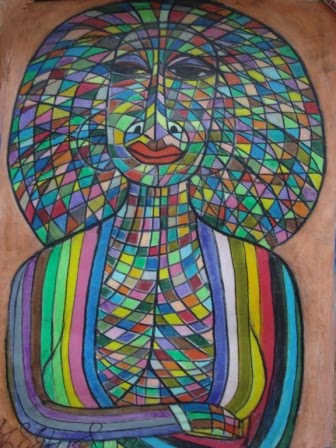
Apart from two fine works from the late 1980s the paintings in this exhibition have been produced in the last two years and are part of a new body of work which the artist calls “House of Women”. Sekano has become fascinated with a “building block” mosaic style – where the women who have inspired him all his life are constructed from these geometric shapes referencing the notion of home and strength as well as musical notes.
Charles Sekano has exhibited widely in Kenya, Holland and Germany, Japan and the U.S.A., his most recent show was at the University of Pretoria in 2008. His works are in private collections across the world and in various museums including Volkekunde Museum, Frankfurt, and the Peabody Essex Museum, Massachusetts.
The works in this exhibition are for sale – for further information please contact Ed Cross at Ed Cross Fine Art ed@edcrossfineart.com or visit http://edcrossfineart.com/ for the complete catalogue and pricelist.
Ed Cross Fine Art thanks Simon Russell for his generous support for this exhibition.
Wednesday, August 25, 2010
Witness: the Spectre of Memory in Contemporary African Art
What the critics say!
"If you are in Edinburgh go to this show. 23 Atholl Crescent - 5 mins walk from the Book Festival site. It's brilliant".
Aminatta Forna
Author of The Memory of Love, The Devil that Danced on the Water and other titles
"Africa's economy is fast moving out of the doldrums, and a new breed of wealthy would-be art patron is looking around at the bargains on offer.
Bonhams and Philips now have auctions with an
If you can persuade him to part with a 'not for sale' work by Lovemore Kambudzi you won't regret it, for this is sure to become an African classic.
True, prices seem high for relatively unknown artists - and I reckon it would take 15-20,000 before Ed and the owner might change their mind about a work that dominates the exhibition If they won't budge, buy up the remaining Donkey pieces, (by Peterson Kamwathi) with their sharp social comment and bitter humour.
Price? About £1500 each. In a couple of years they will be seen as a steal."
Michael Holman
Author of the Fatboy and the Dancing Ladies
Monday, August 23, 2010
Brushes with Memory
Witness: the spectre of memory in contemporary African art is my current exhibition here staged by Ed Cross Fine Art Ltd in the beautiful city of
In this large and highly ambitious reduction Woodcut queuing figures from the abortive 2008 Kenyan elections can be made out amid a mass of ballot boxes.
Memory is the theme of the exhibition – its presence is felt in all acts of creation – but I am interested by the specific roles it plays with the five artists represented and here I will write about three of them. Both Peterson Kamwathi and Lovemore Kambudzi have consciously or otherwise assumed the role of guardians of memories for their respective countries
in this world of ours which worships at the alter of systems of leverage that deliver power and or wealth to the few usually at the expense of the many. Where corporate, individual or national greed are ever present and the sins of many a father apparent if one looks deep enough. The price of freedom is eternal vigilance – there is vigilance in Kamwathi’s work that would be dogged if it were not beautiful. Existing behind the unflinching record of human failings is a strong belief in the soul, a kernel within humanity in
Lovemore Kambudzi from only witness but record – and his recording is detailed and intense - the expressions on the numerous characters that pepper his works are very specific and acutely observed - even the extras in his “cast of thousands” works are individuals, often betraying their emotions through a hunch of the shoulders or the tilt of a hip.
No one would describe Richard Onyango as a political artist, yet whilst his subject matter – mostly his own life both real and imagined, is completely at odds with that of Kamwathi and Kambudzi; his work too, is profoundly informed by politics and social phenomenon. Like Kamwathi, Onyango is driven by a vision of a just
It is a place where people are accorded proper respect regardless of their colour or body type – where women are as powerful as men and more than capable of defending themselves if needs be#
(note the pistol on his late girlfriend Drosie’s belt and the sword on his new fantasy lover, Deborah Teighler once dubbed “the fattest woman in America”). It is an anti-obsolescence world where machinery, engineering and vehicles are revered and well maintained in to old age. It is also a place where people are aware that “dreaming” is a creative process – for Onyango believes that people get what they look for in life. You could say the artist is living proof of his belief in the power of the mind as it was his decision as a child to remember everything he saw (in the absence of a camera) that he attributes to his “photographic memory” and the ability to recall childhood scenes with a high degree of accuracy. Others might attribute it to a variety of autism (is this merely a neurotic and tedious need for labels?) but his clear recollection of his own decision to “record what he was interested in” is compelling.
Have a look at the catalogue of the exhibition...
http://www.edcrossfineart.com/ECFA_Catalogue_and_price_list_Witness_the_Spectre_of_Memory.pdf
Saturday, April 24, 2010
Contemporary African art in St Louis Senegal
Le nord, le sud, l'est et l'ouest
COMPTOIRS DU FLEUVE, ST LOUIS, SENEGAL May 12th-30th 2010
This exhibition brings together works from seven important artists from
Benin, Cote d’Ivoire, Egypt, Kenya, South Africa and Tanzania
Fathi Hassan – Egypt, Peterson Waweru Kamwathi – Kenya
Jems Robert Koko Bi – Cote D’Ivoire, The Late George Lilanga – Tanzania ,
Richard Onyango – Kenya , Charles Sekano – South Africa/Kenya,
Dominique Zinkpe – Benin
Charles Sekano - Two women – House of Women series – pastels on paper – 2009
This exhibition highlights the rich eclecticism inherent in the African continent and its art. It shows works from artists from seven countries (two of whom live in Europe) across different generations and educational backgrounds with works by the late master – George Lilanga di Nyama from Tanzania.
Fathi Hassan
Fathi Hassan (born 1957) is a Sudanese-Egyptian artist known for his installations involving the written word.
Of Nubian origin, Hassan took his diploma at the Naples Art School in 1984; in 1988 he was selected to represent Africa in the "Aperto '88" section of the Venice Biennale. He has exhibited in numerous galleries in Italy, Belgium, Denmark, Egypt, and New York City. Hassan has lived in Italy since 1979, working between Fano and Milan.
Hassan's work often emphasizes power relations and the relationship between the oral and written word; drawing upon his Nubian heritage, he places particular emphasis on the loss of language under the dominance of empire. Most of his scripts are based upon kufic calligraphy, but remain deliberately illegible and impossible to decipher.
Peterson Waweru Kamwathi
Peterson Kamwathi, born in Nairobi in 1980, is one of Kenya’s best regarded young artists and is now establishing himself as a major name in contemporary African art. His work combines subtle conceptual elements and rich content with technical mastery. His main body of work has been in printmaking where he is an acknowledged master of the woodcut process though more recently he has broadened his oeuvre to create several series of charcoal and mixed media works culminating in his “Sitting Allowance” installation which is almost epic in its scale documenting the grim realities of the bungled Kenyan 2007/8 elections
Kamwathi is participating in the 2010 Dak’art Biennale, he has been shown widely in Nairobi at the Rahimtulla Museum of Modern Art, and the Goethe Institute, Nairobi. He is currently in a residency at the Rijksakademie, Amsterdam and will take part in the Museum Africa exhibition - Currencies in Contemporary African Art, Johannesburg in May 2010.
Jems Robert Koko Bi
Jems Robert Koko Bi was born in Cote D’Ivoire in 1966 where he lived and studied until 1997 when he won the DAAD scholarship and commenced his art studies in Germany culminating in his position as master student with Professor Klaus Rinke in 2000.
Koko Bi is principally a sculptor using wood as his medium though it is his extraordinary drawings that are featured in this exhibition. His work is informed by the duality of his own life. He refers to this as a tension between time and space – time represented by the history of his country and continent and the space that he now finds himself occupying as an international contemporary artist – but with Africa and its history following him like a shadow. Koko Bi has been a frequent participant and prize winner at the Dak’Art Biennale.
The Late George Lilanga
George Lilanga (1932-2005 was Tanzanian of Makonde origins began his training as a sculptor in 1961 in Dar-es-Salaam; in 1973 he became associated with the newly founded Nyumba ya Sanaa (House of Arts),.
His playful figures are best understood as heirs to the Makonde shetani, the unruly spirits of Makonde cosmology. Similarly, the complexity of his paintings can be compared to the Makonde ujamaa (tree of life), which signifies unity and solidarity. At the same time, the vibrant inventiveness of Lilanga’s work also testifies to the profound revolution that marked the birth of individualization and personal talent in Africa.
Richard Onyango
Born in Kenya in 1960, Onyango’s work has featured in three major international African exhibitions Africa Now, Africa Remix and Seven Stories about African Art . Onyango’s work hovers between memory and fantasy. Gifted with near perfect recall he is able to remember and reproduce scenes from his childhood and later life in extraordinary detail.
Charles Sekano
Sekano, who is a South African citizen, spent the decades from the 1960s to the 1980s living and working as an artist and Jazz musician in his country of exile, Kenya. An unashamed colourist and admirer of women, he was represented by Ruth Schaffner’s Gallery Watatu until her death. He returned to South Africa after the end of apartheid and sank in to obscurity until his show at the University of Pretoria in 2008. Sekano lives by what he calls “The Three Ps” – Painting, Poetry and Piano.
Dominique Zinkpe
Dominique Zinkpè was born in 1969 in Cotonou in the Republic of Benin. He has participated in numerous exhibitions workshops and residences in Africa, Europe and South America. Zinkpe’s oeuvre is complex and wide ranging, spanning installations, drawings, painting, sculpture and video. There is a restlessness within Zinkpe that prevents him from confining his creative processes to one medium, but his paintings and drawings represent his most intimate work.
Curator: Ed Cross
Ed Cross is an artist, art dealer and curator specialising in contemporary African art. Ed has a Degree in Art History from Cambridge University and now lives and works in London after spending more than twenty years in East Africa working in publishing and the visual arts. His company Ed Cross Fine Art Ltd (www.edcrossfineart.com) promotes and sells a number of the continent’s most important artists.