Anyone heading for Dak'Art 2010 in Dakar , Senegal are warmly invited to come to St Louis to see the show I am putting on there - this is part of the Dak Art Off programme and the St Louis 250 celebrations - it also coincides with The St Louis Jazz Festival which is a jazz festival to die for
http://www.saintlouisjazz.com/Le nord, le sud, l'est et l'ouestCOMPTOIRS DU FLEUVE, ST LOUIS, SENEGAL May 12th-30th 2010
This exhibition brings together works from seven important artists from
Benin, Cote d’Ivoire, Egypt, Kenya, South Africa and Tanzania
Fathi Hassan – Egypt,
Peterson Waweru Kamwathi – Kenya
Jems Robert Koko Bi – Cote D’Ivoire,
The Late George Lilanga – Tanzania ,
Richard Onyango – Kenya ,
Charles Sekano – South Africa/Kenya,
Dominique Zinkpe – Benin
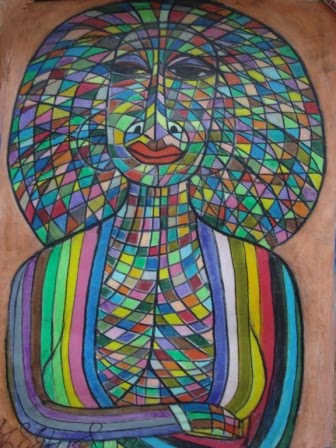
 Charles Sekano - Two women – House of Women series – pastels on paper – 2009
This exhibition highlights the rich eclecticism inherent in the African continent and its art. It shows works from artists from seven countries (two of whom live in Europe) across different generations and educational backgrounds with works by the late master – George Lilanga di Nyama from Tanzania.
Fathi HassanFathi Hassan (born 1957) is a Sudanese-Egyptian artist known for his installations involving the written word.
Of Nubian origin, Hassan took his diploma at the Naples Art School in 1984; in 1988 he was selected to represent Africa in the "Aperto '88" section of the Venice Biennale. He has exhibited in numerous galleries in Italy, Belgium, Denmark, Egypt, and New York City. Hassan has lived in Italy since 1979, working between Fano and Milan.
Hassan's work often emphasizes power relations and the relationship between the oral and written word; drawing upon his Nubian heritage, he places particular emphasis on the loss of language under the dominance of empire. Most of his scripts are based upon kufic calligraphy, but remain deliberately illegible and impossible to decipher.
Peterson Waweru KamwathiPeterson Kamwathi, born in Nairobi in 1980, is one of Kenya’s best regarded young artists and is now establishing himself as a major name in contemporary African art. His work combines subtle conceptual elements and rich content with technical mastery. His main body of work has been in printmaking where he is an acknowledged master of the woodcut process though more recently he has broadened his oeuvre to create several series of charcoal and mixed media works culminating in his “Sitting Allowance” installation which is almost epic in its scale documenting the grim realities of the bungled Kenyan 2007/8 elections
Kamwathi is participating in the 2010 Dak’art Biennale, he has been shown widely in Nairobi at the Rahimtulla Museum of Modern Art, and the Goethe Institute, Nairobi. He is currently in a residency at the Rijksakademie, Amsterdam and will take part in the Museum Africa exhibition - Currencies in Contemporary African Art, Johannesburg in May 2010.
Jems Robert Koko BiJems Robert Koko Bi was born in Cote D’Ivoire in 1966 where he lived and studied until 1997 when he won the DAAD scholarship and commenced his art studies in Germany culminating in his position as master student with Professor Klaus Rinke in 2000.
Koko Bi is principally a sculptor using wood as his medium though it is his extraordinary drawings that are featured in this exhibition. His work is informed by the duality of his own life. He refers to this as a tension between time and space – time represented by the history of his country and continent and the space that he now finds himself occupying as an international contemporary artist – but with Africa and its history following him like a shadow. Koko Bi has been a frequent participant and prize winner at the Dak’Art Biennale.
The Late George LilangaGeorge Lilanga (1932-2005 was Tanzanian of Makonde origins began his training as a sculptor in 1961 in Dar-es-Salaam; in 1973 he became associated with the newly founded Nyumba ya Sanaa (House of Arts),.
His playful figures are best understood as heirs to the Makonde shetani, the unruly spirits of Makonde cosmology. Similarly, the complexity of his paintings can be compared to the Makonde ujamaa (tree of life), which signifies unity and solidarity. At the same time, the vibrant inventiveness of Lilanga’s work also testifies to the profound revolution that marked the birth of individualization and personal talent in Africa.
Richard OnyangoBorn in Kenya in 1960, Onyango’s work has featured in three major international African exhibitions Africa Now, Africa Remix and Seven Stories about African Art . Onyango’s work hovers between memory and fantasy. Gifted with near perfect recall he is able to remember and reproduce scenes from his childhood and later life in extraordinary detail.
Charles Sekano
Sekano, who is a South African citizen, spent the decades from the 1960s to the 1980s living and working as an artist and Jazz musician in his country of exile, Kenya. An unashamed colourist and admirer of women, he was represented by Ruth Schaffner’s Gallery Watatu until her death. He returned to South Africa after the end of apartheid and sank in to obscurity until his show at the University of Pretoria in 2008. Sekano lives by what he calls “The Three Ps” – Painting, Poetry and Piano.
Dominique ZinkpeDominique Zinkpè was born in 1969 in Cotonou in the Republic of Benin. He has participated in numerous exhibitions workshops and residences in Africa, Europe and South America. Zinkpe’s oeuvre is complex and wide ranging, spanning installations, drawings, painting, sculpture and video. There is a restlessness within Zinkpe that prevents him from confining his creative processes to one medium, but his paintings and drawings represent his most intimate work.
Curator: Ed CrossEd Cross is an artist, art dealer and curator specialising in contemporary African art. Ed has a Degree in Art History from Cambridge University and now lives and works in London after spending more than twenty years in East Africa working in publishing and the visual arts. His company Ed Cross Fine Art Ltd (www.edcrossfineart.com) promotes and sells a number of the continent’s most important artists.

 Posts
Posts


 Charles Sekano Princessly Mixed Media on Paper 76 x 50cm
  Charles Sekano Looking Back Mixed Media on Paper 76 x 50cm